FAA Proposes Higher Altitudes for Pilot Oxygen Masks
An NPRM published 24 September 2026 would raise part 135 oxygen-mask altitudes and ease the part 91 rule where quick-donning masks are fitted. Comments close 23 November 2026.
Organizational byline
Updated November 10, 2026
8 min read
Analysis. This is not a new oxygen-mask rule. On 24 September 2026 the FAA published a notice of proposed rulemaking, "Flight Operations: Pilot requirements; Use of oxygen" (91 FR 60530, document 2026-19584, Docket No. FAA-2026-12145, Notice No. 26-17, RIN 2120-AM24). The FAA's recently published rulemaking list shows the same item, with comments due 23 November 2026. The Federal Register text says: send comments on or before that date. Sections 91.211 and 135.89 stay as they are until a final rule says otherwise.
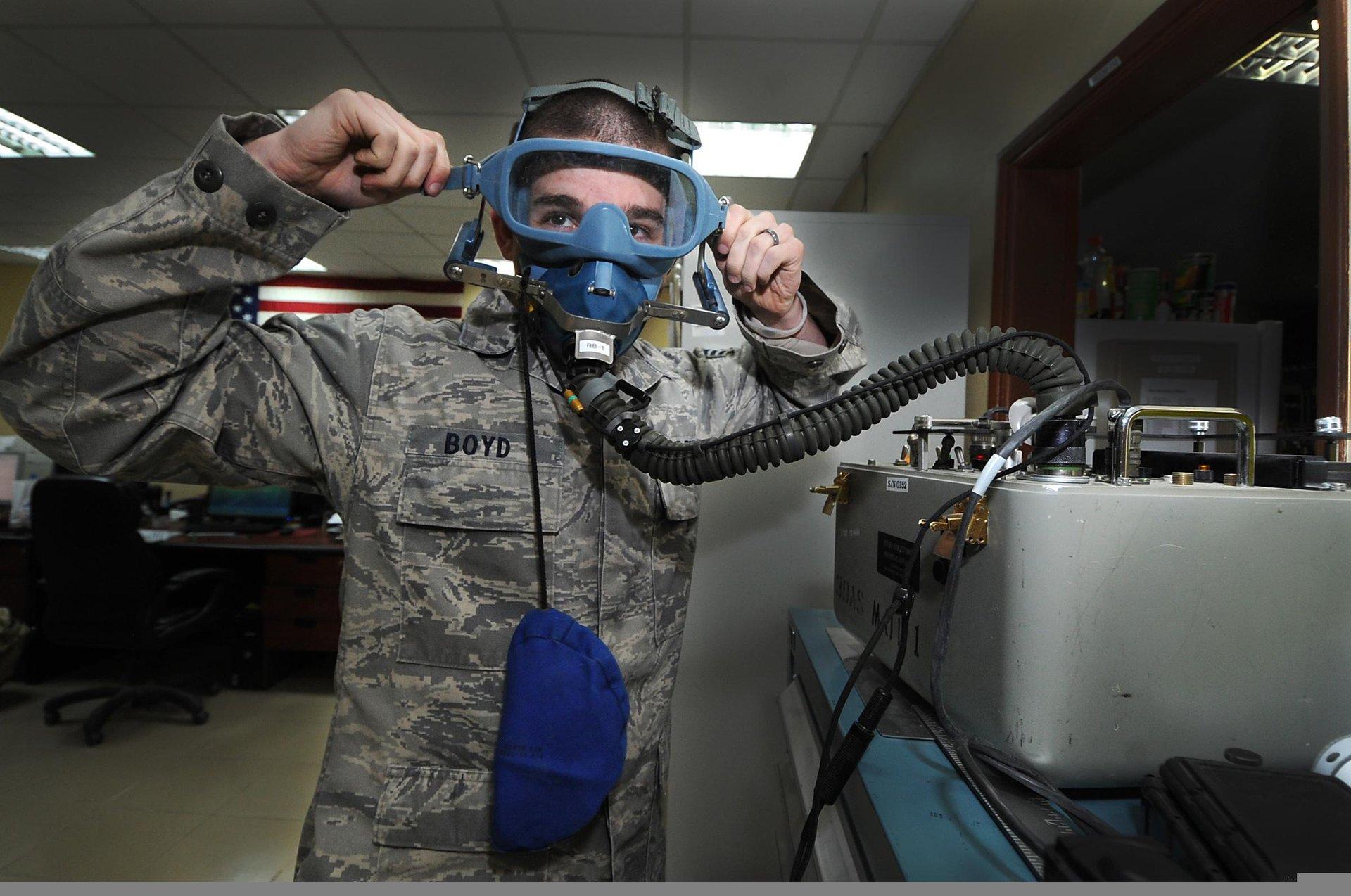
Checked again on 10 November 2026. A Federal Register search for docket FAA-2026-12145 returned only this 24 September proposed rule. The FAA's recently published list still shows comments due 23 November 2026, and it does not list a final rule under this title. The comment deadline is close. That does not make the proposal a rule, and it does not create an effective date. The photograph is a 20 April 2011 U.S. Air Force function check of a 358-series quick-don mask. The file page says the masks were for smoke or fumes in flight. It is not a Part 91 or Part 135 flightdeck, and it is not the quick-donning mask defined in the NPRM.
The proposal would let some pressurized flights climb higher before a pilot must wear a mask. It would not do that evenly. Part 135 with two pilots at the controls is the change Congress told the FAA to propose. The single-pilot part 135 change stops lower. The part 91 change goes further than the statute required.
What would change
Section 834 of the FAA Reauthorization Act of 2024 (Public Law 118-63) directed the Administrator to issue an NPRM on whether to revise 14 CFR 135.89(b)(3) and (b)(4) so that they apply only above flight level 410, after considering safety data, risks, and NTSB investigations and recommendations.
The NPRM does not propose that pair of changes in full.
Part 135, two pilots at the controls. Current § 135.89(b)(3) requires at least one pilot at the controls to wear a secured and sealed oxygen mask above 35,000 feet MSL. The proposed text would move that line to above FL410.
Part 135, only one pilot at the controls. Current § 135.89(b)(4) says that if one pilot leaves a duty station above 25,000 feet MSL, the pilot who remains must put on and use an approved mask until the other pilot returns. The proposed paragraph (b)(4) would say that whenever only one pilot is at the controls above FL350, that pilot shall put on and use an approved oxygen mask. The FAA says the data do not justify taking that lone-pilot line all the way to FL410, which is what the statute asked the agency to consider. The preamble also says the rewrite clarifies that the paragraph applies when only a single pilot is assigned to the flight, not only when a second pilot steps away.
The proposed introductory text of § 135.89(b)(2) would read: "Whenever a pressurized aircraft is operated at altitudes above flight level 250 through flight level 350, unless each pilot has an approved quick-donning type oxygen mask—". The Federal Register prints that clause as the revised introductory text. It does not restate the existing subparagraphs under (b)(2).
Part 91, pressurized cabins. This part of the NPRM is the FAA's addition. The statute did not require it. The FAA says the same airplanes often fly under part 135 or part 91, that pressurization events in modern business aircraft at these altitudes are rare, and that part 91 should tolerate more risk than commercial operations.
Current § 91.211(b)(1)(ii) requires one pilot at the controls to wear a secured and sealed mask above FL410, and also requires the only pilot at the controls to wear one above FL350. With two pilots and quick-donning masks, the wearing requirement can already be deferred up to FL410. The proposed § 91.211(b)(2) would require one pilot to wear and use a mask above FL350 unless each pilot has a quick-donning mask that can be placed on the face with one hand from the ready position within five seconds, supplying oxygen and properly secured and sealed. The proposed exception has no FL410 cap. The FAA's footnote points to the quick-donning definition in 14 CFR 25.1447(c)(2)(i), which also says the mask must go on without disturbing eyeglasses or delaying emergency duties, and must allow normal communication while in place.
The proposed part 91 text would also delete the separate rule that the remaining pilot must don a mask if the other pilot leaves the controls above FL350. The ten-minute supplemental-oxygen supply for occupants above FL250 would remain.
Part 121 is not in this NPRM. A 2020 final rule, implementing the FAA Reauthorization Act of 2018, already moved the part 121 case in which one pilot leaves the controls from FL250 to FL410. The FAA notes that change left part 121 less restrictive than parts 91 and 135. This proposal would not amend § 121.333.
Who it would cover
Part 135 is commuter and on-demand operations by a person who must hold an air carrier or operating certificate under part 119. Part 91 is the default for non-commercial and general-aviation flight, including pressurized airplanes that are not on a part 135 certificate for that flight. A quick-donning mask is the condition on the part 91 relief and on the revised part 135 lead-in between FL250 and FL350. An airplane without that mask would not get the exception the proposed text describes.
The NPRM is about when a pilot must wear a mask in a pressurized airplane. It does not rewrite passenger oxygen rules, unpressurized-aircraft rules, or the part 121 mask rule.
How to comment
Comments are due on or before 23 November 2026. The Federal Register identifies Docket No. FAA-2026-12145 and lists four methods:
- The Federal eRulemaking Portal at regulations.gov. The document page links the comment form for FAA-2026-12145.
- Mail to Docket Operations, U.S. Department of Transportation, 1200 New Jersey Avenue SE, Room W58-213, West Building, 5th Floor, Washington, DC 20590-0001.
- Hand delivery or courier to that room, between 9 a.m. and 5 p.m. Eastern, Monday through Friday, except Federal holidays.
- Fax to Docket Operations at (202) 493-2251.
The Department says it posts comments, without edit, including personal information the commenter provides. The docket can be read at regulations.gov.
What the FAA says about safety and cost
The FAA says the likelihood of depressurization is "extremely improbable," so it expects no safety impact and no safety cost from the proposed changes. It says the estimated effect is less pilot-oxygen use on ordinary flights, and therefore less frequent tank servicing.
It puts a market range on a recharge of $100 to $400, varying by location, usually charged as a flat fee. It says it does not have the refill counts it would need to estimate the actual saving. Instead it illustrates a one-percentage-point drop in a proxy: the 2023 activity survey's part 91 and part 135 turbojet and multiengine-turboprop landings, which the FAA calls roughly 4.7 million. The FAA's own one-percent figure is 46,589 operations, not a fresh multiplication of the rounded 4.7 million. Multiplied by the $100 to $400 range, the FAA gets $4.7 million to $18.6 million a year in servicing fees per percentage point. The FAA says the landing count may over-count, because it can include twin turboprops that cannot reach the altitudes where a mask is required, and that operations vary from year to year. It asks for comment on the estimate.
The Office of Management and Budget has determined the proposal is not a significant regulatory action under Executive Order 12866. The FAA proposes to certify that the rulemaking would not have a significant economic impact on a substantial number of small entities, and it asks for comment on that certification too.
None of those figures is a bill operators owe, and none of them changes a flight today. They are the agency's illustration of a rule that is still a proposal.
What stays in force on 23 November
The comment deadline is not an effective date. On 23 November 2026, unless a separate final rule has been published and taken effect, a part 135 crew still follows the current lines: one pilot wearing a mask above 35,000 feet MSL when two are at the controls, and the remaining pilot donning above 25,000 feet MSL if the other leaves the station. A part 91 pressurized flight still follows the current FL350 and FL410 wearing rules. A final rule would need its own effective date before any of the altitudes in the proposed amendment apply.