FAA Says the First U.S. Digital Towers Are Operating at Bartow and Kenai
The FAA said on 6 November 2026 that digital towers are operating at Bartow, Florida, and Kenai, Alaska. Five more airports are planned, with no dates. Cameras supply a 360-degree view. Controllers still separate traffic.
Organizational byline
Updated November 12, 2026
5 min read
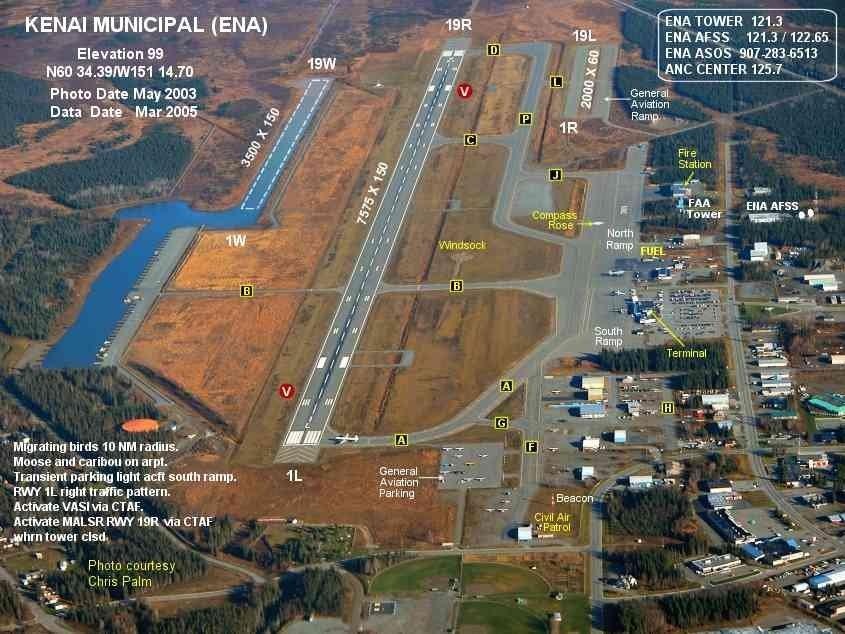
News. The FAA said on 6 November 2026 that the first digital air traffic control towers in the United States are operating at Bartow Executive Airport in Florida and Kenai Municipal Airport in Alaska. Controllers still separate aircraft. The new equipment is a camera and display system, not a substitute for that job.
The photograph is the FAA's annotated aerial of Kenai Municipal Airport. The image itself says the photo is courtesy of Chris Palm, dated May 2003, with chart data from March 2005, and it labels an FAA tower and a tower frequency. It does not show the 2026 cameras. No current photograph of the Bartow installation was used. The 2003 label is not a description of the 2026 cab.
The 6 November release says digital towers use cameras and displays to give controllers a continuous 360-degree view of runways, taxiways, and the surrounding airspace, plus information to support work they already do. Administrator Bryan Bedford's quoted line is that controllers "continue to do the critical job of keeping aircraft safely separated," and that the towers give them "greater visibility of airport activity and more information." The release says the FAA selected the Frequentis system.
The agency's digital-towers page describes the same picture in more detail: a real-time 360-degree view on a video wall, airfield audio reproduced in the control room, and tools that can include target detection, data tags, infrared cameras, and better low-light visibility. It says a system for federal contract towers has to show it meets functional, performance, and operational visual requirements, including equipment failures, and that evaluators measure the delay between an event on the airfield and its appearance on the display.
Two operating sites, and five without dates
The release names five further airports that "will soon get these systems," funded from what it calls the Working Families Tax Cut Act: Winter Haven Regional Airport and Venice Municipal Airport in Florida, Montgomery County Airpark in Maryland, Johnston Regional Airport in North Carolina, and Durango-La Plata County Airport in Colorado. Montgomery County Airpark is the fifth. The release calls those five non-towered. It does not call Bartow or Kenai non-towered. It gives no month for any of the five.
The digital-towers page dates two earlier milestones to September 2026. It says the FAA issued the first system design approval to Frequentis's smartVISION digital tower system for sponsor-owned federal contract tower airports with a single runway and Class D airspace, and that the first operational non-federal control tower digital tower system went operational at Bartow that month. The 6 November release is the public announcement that towers at both Bartow and Kenai are operational. The page does not give Kenai a separate start month. Approved use, on that page, is Class D airspace at single-runway airports. The page also says the systems are used with the equipment in Advisory Circular 90-93 and the minimum equipment list in FAA Order JO 7210.78, and that controllers still work to Orders JO 7110.65 and JO 7210.3.
The same page says the Working Families Tax Cut Act allocated $50 million for digital towers at qualified non-towered airports, as part of the Brand New Air Traffic Control System initiative, and that the 2024 reauthorisation told the FAA to set a framework and a timeline for approving and deploying them. The $50 million figure is the allocation on that page. The release does not say the five named airports exhaust it.
Testing, the release says, ran for years at the William J. Hughes Technical Center in Atlantic City and at other locations. The digital-towers page says the approved system's testing there covered what controllers could see, the workstation layout, how they responded to equipment failure, and whether the training material was suitable.
How this sits next to the older remote-tower page
A March explainer on this site, FAA remote towers in 2026, described the approval path when the FAA's remote-tower page still treated the systems as unapproved for use in the National Airspace System. The FAA now titles that planning page Digital Tower (DT) Systems and says it is changing the name from "remote tower" to "digital tower" so the label does not imply the room has to be off the airport. Displays can still be off the airport. The page still calls a digital tower a proposed solution, and it still says the site will be updated when, and if, a system design approval is issued.
That planning page and the 6 November release are both FAA pages, and they do not say the same thing about approval. This article follows the release and the digital-towers technology page for the claim that Bartow and Kenai are operating and that a Frequentis approval for single-runway Class D contract towers was issued in September 2026. It does not treat the older planning page as a retraction of those two documents. It also does not treat two operating airports as a nationwide replacement for tower cabs.