FAA Adopts a New Tail-Rotor Blade AD for Listed EC135s and the EC635T2+
AD 2026-22-10, effective 14 December 2026, supersedes AD 2024-04-10 for nine Airbus Helicopters models. It incorporates EASA AD 2026-0032 with stated exceptions. It is not the EC130 door AD.
Organizational byline
Updated November 10, 2026
6 min read
The FAA has adopted AD 2026-22-10 for specified Airbus Helicopters Deutschland EC135 and EC635 helicopters. It was issued on 30 October 2026, published on 9 November 2026 (91 FR 70771), and is effective 14 December 2026. The amendment is 39-23512, Docket No. FAA-2026-7230. It replaces AD 2024-04-10 (amendment 39-22689, 89 FR 15431, 4 March 2024).
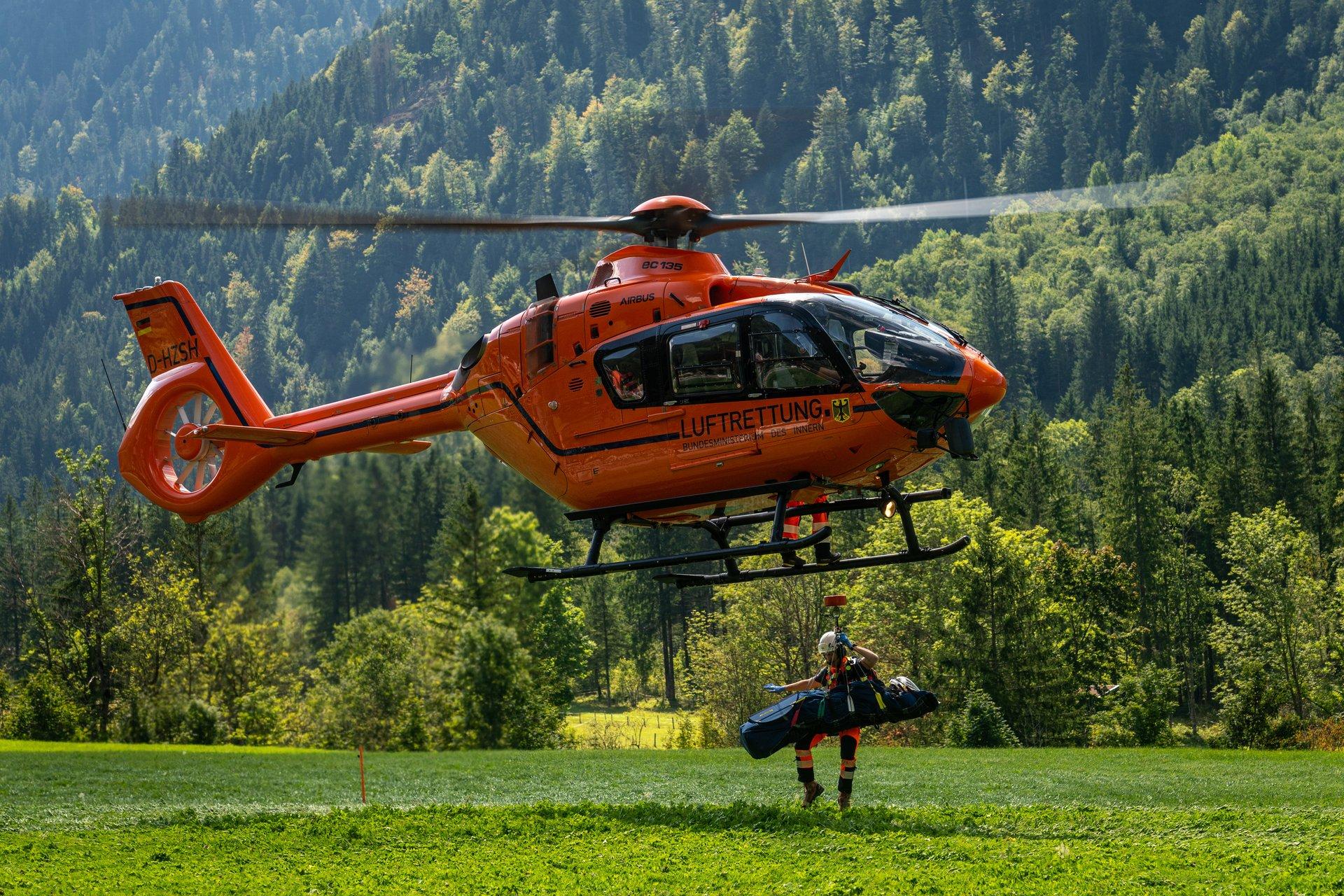
The photograph shows German air-rescue EC135 D-HZSH on 8 September 2021. It is an EC135, which is the family in the AD. It is not identified as the helicopter in the crack report, and the picture does not show a blade crack or a US-registry aircraft.
This is not the EC130B4 passenger-door rule in Monday's AD 2026-22-08 note. The subject here is JASC code 6410, tail rotor blades.
Which helicopters and which blades
The FAA AD applies to all Airbus Helicopters Deutschland Model EC135P1, EC135P2, EC135P2+, EC135P3, EC135T1, EC135T2, EC135T2+, EC135T3, and EC635T2+ helicopters, certificated in any category. There is no serial-number cut in that applicability paragraph.
It does not apply to the EC635 P2+, EC635 P3, EC635 T1, or EC635 T3. The FAA says those models have no FAA type certificate. EASA AD 2026-0032, which the FAA incorporates, does list them.
The blade limit is in that EASA AD, dated 19 February 2026 and effective for EASA on 5 March 2026. An affected part is a tail-rotor blade assembly part number L642A2002111 or L642A2002112. A different concurrent EASA directive, AD 2026-0031, covers part number L642A2002121. That part number is not the affected part in AD 2026-0032, and it is not what this FAA AD adopts.
EASA splits helicopters that have an affected blade installed (Group 1) from those that do not (Group 2). It also splits models for the repeat interval. Group A is the EC135 P1, P2, P2+, T1, T2 and T2+, plus the EC635 P2+, T1 and T2+. Group B is the EC135 P3 and T3 and the EC635 P3 and T3. After the FAA's type-certificate exclusion, the FAA AD reaches the Group A models except the EC635 P2+ and EC635 T1, and the Group B models EC135 P3 and EC135 T3.
The FAA says the AD was prompted by a separated tail-rotor blade assembly from a crack caused by intergranular corrosion. If not addressed, the FAA says that could separate a blade assembly and reduce control of the helicopter. EASA's account is a vibration report, a ruptured blade, and the same corrosion mechanism. Neither text names the helicopter in the photograph.
What the FAA actually requires
Except for the exceptions below, the FAA requires the actions and compliance times in EASA AD 2026-0032. The inspection steps themselves are in Airbus Helicopters Emergency Alert Service Bulletin EC135-64-11-0001, issue 003, dated 5 February 2026. This article does not restate that bulletin. The AD is the compliance document.
Where the EASA AD says "flight hours," the FAA says hours time-in-service. Where the EASA AD uses its own effective date, the FAA uses 14 December 2026. Where the EASA AD uses 29 January 2024, the FAA uses 19 March 2024, the effective date of AD 2024-04-10.
The opening inspection in EASA paragraph (1) is rewritten by the FAA. An affected part must be inspected before it accumulates 685 hours time-in-service since first installation on a helicopter, or within 10 hours time-in-service after 19 March 2024, whichever occurs later. Repeats then follow EASA Table 1, with flight hours read as hours time-in-service:
| EASA model group | Last inspection method | Repeat interval |
|---|---|---|
| Group A | B, C or D, or method A done before the effective date | 30 hours |
| Group A | E, visual | 7.5 hours |
| Group B | B, C or D, or method A done before the effective date | 20 hours |
| Group B | E, visual | 5 hours |
EASA Note 2 says method A, a dye-penetrant inspection with increased temperature, is no longer acceptable from the effective date. The table still names method A so that an earlier method-A inspection can set the next interval. For an FAA operator, that effective date is 14 December 2026.
EASA Table 2 sets the first inspection after an affected blade is installed. Note 3 says that if the hours since the last inspection required by the AD are unknown, the next inspection is before the next flight after installation. The FAA's hour substitution applies there too. The table is short and easy to mis-copy, so it is not reproduced here.
If any required inspection finds a crack, the affected blade is replaced with a serviceable part before the next flight. Replacing every affected blade with a blade that is not an affected part, and not putting an affected part back on, is terminating action for the repeats.
The FAA does not adopt EASA paragraph (3). In the EASA AD, that paragraph limits when fluorescent-penetrant method D may be used after a dye-penetrant inspection. Separately, FAA paragraph (h)(5) says what to do when the incorporated material's paragraph 4.3 recommends a type II visible-dye inspection: eddy current or fluorescent penetrant, with type II visible dye (method B) still allowed only if that method was used on the part before. If the history is unknown, the FAA requires the surfaces to be cleaned and then an eddy current or fluorescent penetrant inspection. Those two FAA statements are both in the AD. This article does not merge them into a shop procedure.
The FAA also drops the EASA remarks, and it does not require the reports or the return of removed parts that the service material requests. Special flight permits under 14 CFR 21.197 and 21.199 are not allowed.
The FAA estimates 359 US-registry helicopters. Its published cost for inspecting one blade assembly is 3 work-hours at $85, plus $50, up to $305, and up to 10 assemblies a helicopter. Replacement of one assembly is the same labour plus $4,900 parts. The FAA says it cannot tell how many blades will need replacement. The NPRM was published on 30 July 2026 (91 FR 47994). The FAA received no comments and adopted it as proposed, apart from minor editorial changes.
Keeping the model, the part number and the one-time versus repeat actions distinct is the records problem described in the AD compliance software guide. The guide does not say whether a particular helicopter is inside this AD.