NPRM 2026-23198 Would Inspect Certain 787-8 Fasteners for a Lightning Ignition Path
A 13 November 2026 proposal would inspect wing-skin fasteners, fuel tanks, surge tanks and dry bays on certain Boeing 787-8 airplanes and add airworthiness limitation 57-AWL-18. The FAA estimates 14 U.S. airplanes. Comments close 28 December. It is not a final rule.
Organizational byline
Updated November 16, 2026
4 min read
News. This is a proposal, not a final airworthiness directive. On 13 November 2026 the FAA published a notice of proposed rulemaking for certain Boeing 787-8 airplanes. Federal Register document 2026-23198 is at 91 FR 73181. Docket No. FAA-2026-13802, Project Identifier AD-2026-00597-T. Comments are due 28 December 2026. Paragraph (b) names no earlier FAA AD. The notice sets no effective date.
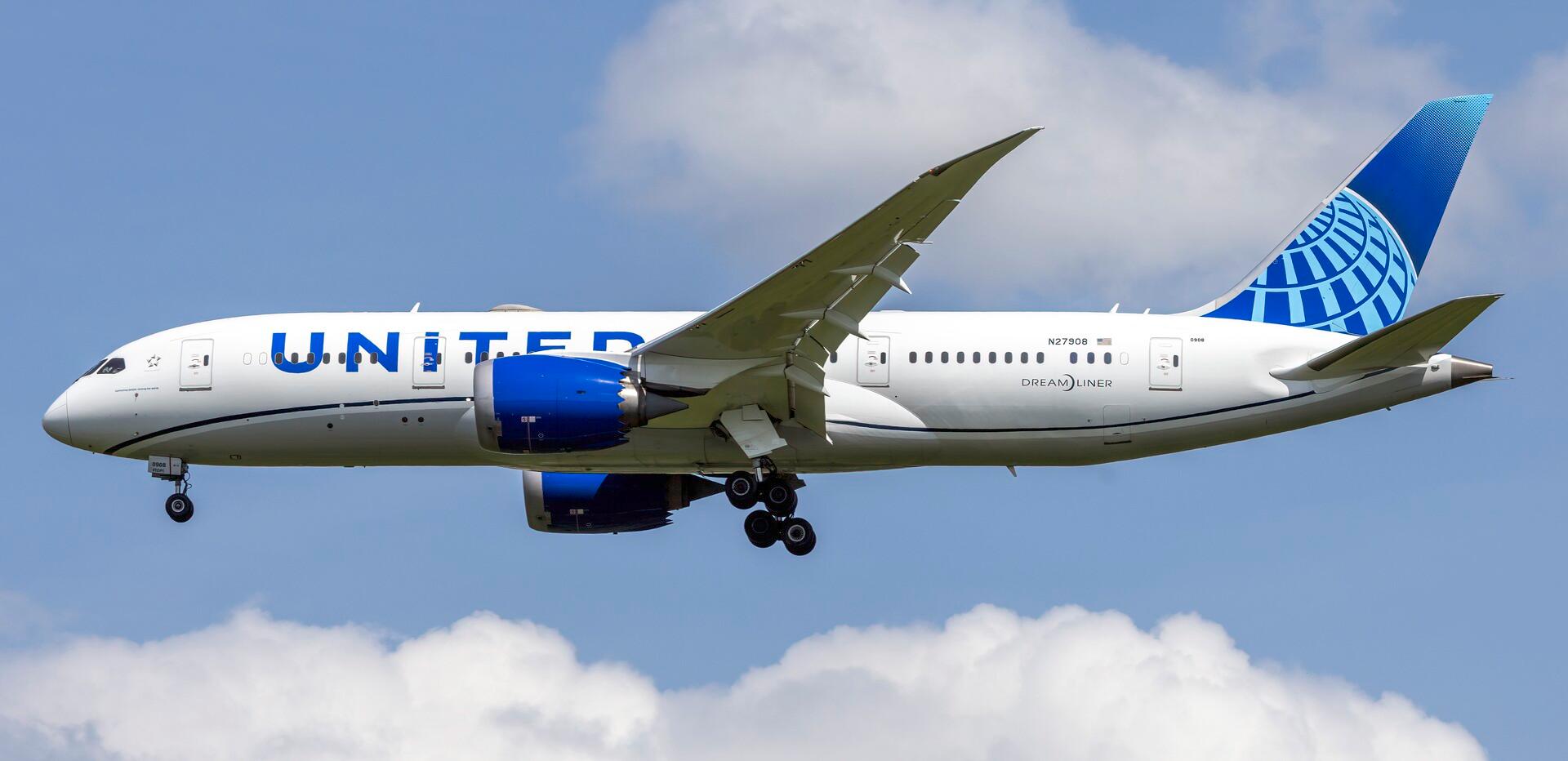
The photograph is United 787-8 N27908 on approach to Dulles on 30 April 2025. It is the model named in the proposal. It is not identified as an airplane in the Boeing effectivity, and it does not show a fastener.
Applicability is not every 787-8, and it is not the 787-9 or the 787-10. Paragraph (c) applies to 787-8 airplanes identified in Boeing Alert Requirements Bulletin B787-81205-SB570039-00 RB, Issue 001, dated 8 June 2026. The subject code is ATA 57, wings.
What the FAA says the fasteners do not do
The FAA says it received a report that wing-skin outer-mold-line penetrating fasteners installed with threaded nuts, and without cap seals, do not reliably protect against ignition sources when they carry direct-attachment lightning current. If that is not addressed, the FAA says the condition could create an ignition source inside the wing fuel tanks, the surge tanks, or the dry bays during a lightning strike, and a fire or explosion.
The bulletin the proposal would require specifies inspections between rib 25 and rib 31 on the left and right wing for wing-skin penetrating fasteners with a threaded nut next to the electromagnetic-effects sleeve. It also specifies inspection of the left and right wing fuel tanks, surge tanks and dry bays for threaded nuts on fasteners that penetrate the upper and lower wing skin. On condition, the material calls for replacing affected sleeves with a new sleeve, installing a cap seal on wing-skin penetrating fasteners found with a threaded nut, and repairing to Boeing instructions where the bulletin says to contact Boeing. Paragraph (h)(2) would require that repair before further flight under an approved method.
The same material would require the actions in airworthiness limitation 57-AWL-18, "Inspection Requirements for Cap Seals on In-Tank Fasteners between Side of Body (SOB) Rib and Rib 2," and would put 57-AWL-18 into the maintenance program. Concurrent work includes an upper and lower panel stringer base-flange edge-seal inspection and seal application, and incorporation of 57-AWL-3 and 57-AWL-19. Where the bulletin dates a compliance time from its own Issue 001 date, the proposed AD would use the effective date of the final rule. After that program change, no alternative action or interval could be used unless approved as an alternative method of compliance.
Paragraph (j) drops one reporting step. For the Table 1 Condition 1 and Condition 2 airplanes in Table 2, the bulletin's instruction to do 57-AWL-18 includes a report. The proposed AD would not require that report for compliance with the AD. The FAA says the exemption applies only to this AD. If the same inspection is done as routine maintenance or under any other requirement, the report in the limitation would still have to be sent.
Two final 787 rules this proposal does not replace
This notice does not supersede either of the 787 directives already covered here. AD 2026-22-05, effective 7 December 2026, is a final rule on sealant inspections in the center wing fuel tank of certain 787-8, 787-9 and 787-10 airplanes. AD 2026-17-02, effective 1 October 2026, is a final rule on ultrasonic inspection of wing splice plates. Document 2026-23198 is a lightning-fastener proposal limited to the 787-8 airplanes in a different bulletin. It has no effective date.
What the FAA priced
The FAA estimates 14 airplanes of U.S. registry. Inspections are 63 work-hours at $85, or $5,355 an airplane and $74,970 for those 14, with no parts cost in that line. Concurrent actions are up to 220 work-hours, $18,700, with negligible parts, and up to $261,800 on U.S. operators. Revising the maintenance program is estimated at an average of 90 work-hours an operator, $7,650, because the FAA treats that change as a fleet action rather than a per-airplane one.
On condition, the table prices replacement of electromagnetic-effects sleeves at up to 120 work-hours, $10,200, parts up to $10,830, and up to $21,030 a product. Cap seals on fasteners are up to 901 work-hours, $76,585, parts up to $162,970, and up to $239,555 a product. The FAA says it has no definitive data for the cost of the on-condition repairs, and it does not print a U.S. total for those two rows. The notice was issued on 9 November 2026.