FAA Proposes Flap-Actuator Checks on Every Diamond DA 50 C
A 12 November 2026 NPRM would require inspection, modification, and repeat checks of DA 50 C flap actuators after a failure that reduced aileron control. The FAA estimates 30 U.S. airplanes. Comments close 28 December. It is not a final rule.
Organizational byline
Updated November 12, 2026
5 min read
News. This is a proposal, not a final airworthiness directive. On 12 November 2026 the FAA published a notice of proposed rulemaking for all Diamond Aircraft Industries GmbH Model DA 50 C airplanes, certificated in any category. Federal Register document 2026-23068 is at 91 FR 72819. Docket No. FAA-2026-13809, Project Identifier MCAI-2026-00761-A. Comments are due 28 December 2026. The notice sets no effective date, and paragraph (b) names no earlier FAA AD.
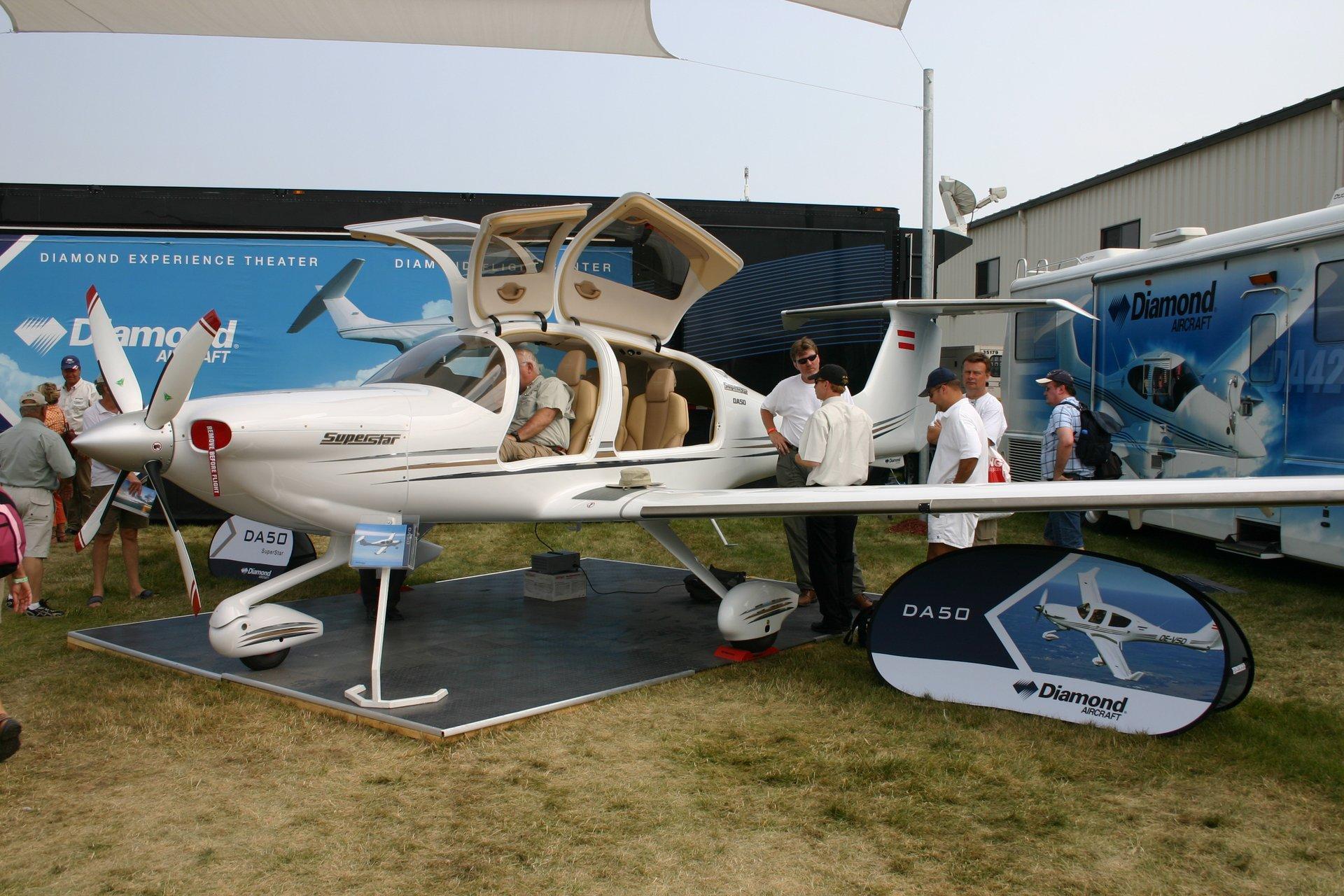
The photograph is a Diamond DA50 at Oshkosh in July 2007. It is the type family. It is not identified as a DA 50 C, and it does not show a flap actuator.
The FAA says the proposal follows EASA AD 2026-0140, dated 15 July 2026. EASA is the technical agent for the European Union member states. The NPRM says reports of flap-actuator failures left crews unable to extend the flaps, and that investigation found the actuator could interfere with the aileron control system. There was one report of reduced aileron control. If the condition is not detected and corrected, the FAA says it could leave the flaps unextendable, limit aileron travel, and reduce control of the airplane. The subject code is JASC 2752, trailing-edge flap actuator.
The FAA calls the proposed AD an interim action. It says the manufacturer is still investigating, and that further rulemaking is possible depending on that work. Nothing in the notice grounds an airplane today. Shops do not have a compliance clock until a final rule sets an effective date.
What adoption would require
If adopted as proposed, paragraph (g) would set three clocks, each running from the effective date or from the modification, and each using whichever limit comes first.
The initial inspection of the flap actuator would be due within 50 hours time-in-service or 12 months after the effective date. It would follow Section III, steps 1 through 15, of Diamond Work Instruction WI-MSB 50-016, Revision 0, dated 9 July 2026. The NPRM describes that inspection as a check for displacement of the black slide grommet and a check that the rod-end bearing is a tight fit.
Modification of the flap actuator would be due within 100 hours time-in-service or 12 months after the effective date, under Section IV, steps 1 through 34, of the same work instruction.
Repetitive inspections would start within 200 hours time-in-service or 12 months after that modification, and then repeat at intervals not to exceed 200 hours time-in-service or 12 months, whichever comes first. Those repeats follow Section V, steps 1 through 13, and look for a broken actuator torque seal on the jam nuts at the rod-end bearing.
If either the initial inspection or a repeat finds a discrepancy as defined in the work instruction, the applicable corrective action is required before the next flight. Where the work instruction says to contact Diamond, the proposed AD would require approved instructions before further flight, from the FAA's International Validation Branch, from EASA, or from Diamond's EASA design organization, with the design organization's authorized signature if that is the path used. Where the work instruction says to "discard" parts, the proposed AD would require those words to be read as "remove from service."
As of the effective date, an unmodified flap actuator could not be installed unless it had been modified under paragraph (g)(2) and the applicable inspections and corrective actions had been done. Results of the inspections and of the modification would have to be sent to Diamond on the execution report in Mandatory Service Bulletin DAI MSB 50-016, also dated 9 July 2026. The report would be due within 30 days after the work, or within 30 days after the effective date, whichever is later.
This article does not restate the work-instruction steps. The steps are the maintenance instruction. The NPRM is the proposal that would make them mandatory.
How many airplanes, and what the FAA priced
The FAA estimates the proposal, if adopted, would affect 30 airplanes of U.S. registry. That figure is the agency's estimate in the cost section. It is not a serial-number list.
At the FAA's $85 labor rate, the published costs are 1 work-hour and no parts for each initial inspection ($85 an airplane, $2,550 for the U.S. fleet per inspection); up to 5 work-hours and up to $2,250 in parts for the modification (up to $2,675 an airplane and up to $80,250 for the fleet); the same 1-hour inspection cost for each repeat; and 1 hour to submit each execution report. The FAA says the proposal is not a significant regulatory action under Executive Order 12866, would not affect intrastate aviation in Alaska, and would not have a significant economic impact on a substantial number of small entities under the Regulatory Flexibility Act.
The notice was issued on 9 November 2026 and signed by Steven W. Thompson, Acting Deputy Director, Compliance & Airworthiness Division, Aircraft Certification Service.